WordPress consent implementations usually fail at a boundary, not at a toggle. A banner can save a preference, GTM can contain a consent template, and the theme can load the expected scripts—yet the browser can still follow an incorrect or unintended sequence.
Consent Mode v2 on WordPress: Designing the Consent-to-Tagging Boundary
A vendor-neutral reference architecture for WordPress teams and agencies: define ownership, preserve ordering, make release decisions explicit, and test the system as part of every deployment.
For direct implementation details, Basic-versus-Advanced behaviour, minimal examples and clean-browser verification, see the companion WordPress Consent Mode implementation guide.
Design the boundary, not just the banner
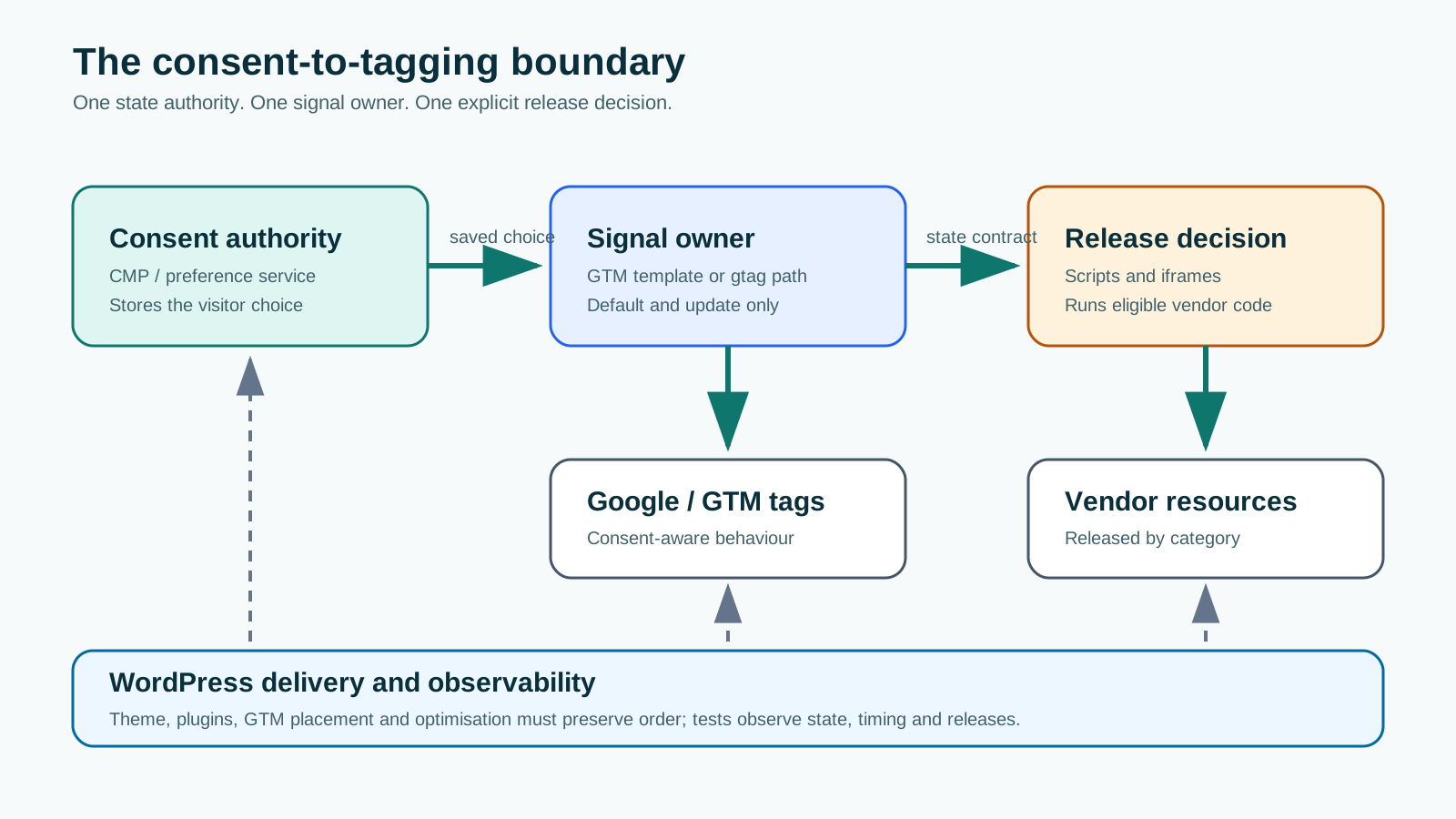
Consent Mode is a signal contract for Google tags. Prior blocking is an execution-control mechanism for tags, scripts and iframes. They can respond to the same visitor preference, but they answer different questions.
- The CMP or custom preference service owns collection, persistence and withdrawal of the visitor choice.
- One Consent Mode adapter owns the Google default and update path.
- An explicit gate decides whether a resource may execute or be released.
- WordPress delivery code determines whether this order reaches the browser unchanged.
The useful invariant is traceability: a saved choice flows through one state authority, one signal owner and one release decision.
Assign responsibilities deliberately
Consent authority
The consent authority owns categories, save/reject actions, persistence and the mapping from a saved preference to a defined consent contract. It should emit a clear outcome, such as analytics allowed and advertising denied, rather than asking downstream components to infer consent from banner CSS, cookie names or DOM state.
Consent Mode adapter
Choose one owner for Google signals: a documented CMP integration, a GTM consent template, or a direct Google-tag path controlled by a custom WordPress integration. Google requires the default state before measurement-emitting commands and an update after the visitor decision. In GTM, use Consent Initialization for the default path and the documented consent APIs in a custom template.
Do not make a CMP template, theme snippet and optimisation plugin all write defaults “for safety.” That creates conflicting state ownership. Record the decision: Google Consent Mode signals are owned by [component]; no other component emits defaults or updates.
Permission to execute
The execution gate owns category-aware release of scripts and iframes. It must account for static markup, GTM Custom HTML, widgets, SPA routes and dynamically inserted resources. A successful Google consent update does not prove that a non-Google vendor was held; a held vendor does not prove Google received the intended signal. Test both boundaries.
WordPress delivery is part of the system
Use the normal WordPress script lifecycle to register and enqueue assets. wp_add_inline_script($handle, $data, 'before') can order a bootstrap before its associated registered handle. That control is deliberately limited: it does not order independently injected scripts from a theme, page builder, GTM snippet, cache/CDN transform or another plugin.
Maintain an inventory of all tag sources and make one component responsible for each. A WooCommerce template, landing-page builder, multilingual header or custom application shell can be a separate delivery surface; include each in the test matrix.
Reference event sequence
- WordPress emits the consent bootstrap in its intended location.
- The signal owner records the default state.
- Tag loaders start according to the selected implementation model.
- The CMP restores or obtains the visitor preference.
- A saved choice is persisted and passed to the signal owner.
- The signal owner updates Google’s state.
- The release gate permits only eligible resources.
- Observability records the transitions and their order.
These steps are not atomic. Navigation, asynchronous failures and dynamic insertion can interrupt them, so transitions need an owner, idempotent behaviour and observable evidence.
Failure modes to design against
- Late defaults: a footer injection, delay feature or asynchronous component runs after measurement. Keep the bootstrap small and deterministic.
- Conflicting writers: multiple components emit defaults or updates. Remove competing writers; do not rely on incidental ordering.
- Dynamic bypass: a widget or experiment inserts code outside the shared gate. Review direct DOM insertion as an architecture exception.
- Optimisation reordering: defer, async, concatenation or delay-JavaScript changes the delivery graph. Treat ordering as a non-regression requirement.
- Withdrawal as “unload”: stop future release and future events where technically possible; do not claim executed JavaScript or transmitted requests are reliably reversible.
Observe transitions, not screenshots
A banner screenshot cannot prove consent architecture. In a controlled environment, inspect which component emitted the default, the source and time of the saved preference, the update source, resources held or released, and ordering across templates and optimisation settings.
Google Tag Assistant and browser network tooling are useful diagnostic inputs. For agencies, the durable asset is a regression suite that verifies a defined contract across a clean profile and controlled consent states.
Regression-testing strategy
- No choice: verify the chosen model’s default-state and loading contract.
- Explicit reject: verify persisted denied state and that inappropriate vendor releases do not occur.
- Selective acceptance and preference change: verify only the intended categories and signals change.
- Dynamic insertion: verify late tags use the same gate.
- Optimisation enabled: verify production output preserves the required order.
- Template coverage: test homepage, posts, checkout, page-builder pages and separate application shells.
Automated tests should flag unexpected or conflicting default writers, contradictory state ownership, an update before a saved choice, or a tag released before its category permits it. Keep a manual checklist for third parties whose behaviour cannot be simulated.
A practical agency architecture
- CMP: preference UX, persistence, category mapping and a documented event contract.
- GTM or direct adapter: the single owner of Google Consent Mode defaults and updates.
- Release gate: category-aware control for non-Google vendors, iframes and dynamic insertion.
- WordPress integration: predictable bootstrap placement and an inventory of tag sources.
- Optimisation owner: explicit exemptions and a production-output regression check.
- Engineering owner: traceable configuration and regression tests after theme, plugin or CDN changes.
Quality is not measured by whether a banner appears. It is measured by whether a visitor decision crosses the consent-to-tagging boundary once, in the intended order, through the intended owners—and whether the team can still prove that after the next WordPress change.